For thousands of years Precious Metals (PM) such as Gold (Au) and Silver (Ag) have been utilized as real money for exchange, wealth store, and metric of value. While I am NOT an advocate of one single commodity backing our money (like a gold standard), I do believe that the price trend of PMs are the most important indicators of the value of fiat money, plus the crimes of corrupt banking corporations and governments that manipulate PM prices. The "Canary in the coal mine" is Gold - AuCanary.
Today's FINVIZ 5 Minute Charts - (for other charts go to the bottom of this page)
Click HERE for more real-time ADVANCED CHARTS and see the bottom of this page for more real time price updates.
FINVIZ - Financial Visualizations and Charts here: here.
The reason is simple: central planning script 101, page 1. As we noted earlier, the RBI did a very surprising overnight repo rate cut from 8.5% to 8.0%, the first in three years, and in other words it has just joined the global central planning cartel in attempting to stimulate the economy nominally, even as inflationary packets still abound across the land (see China), by reliquidifying. Yet what does that mean from a modern monetarist standpoint: why crush gold as an alterantive to the local paper currency of course. Sure enough:
INDIA ECONOMY SECRETARY: EXPECT TO LOWER GOLD CONSUMPTION IN ECONOMY - DJ
And there you have it: because the last thing India needs is a surge in gold buying now that it too has joined the global reliquification parade. That said, we are curious in what parallel universe will liquidity easing result in less demand for hard assets. Ask the algos who are selling on nothing but headlines, yet oddly ignoring the fact that India and now Austrialia appear set to enter the race to CTRL-P's bottom.
Consequently, gold prices will again depend on whether the four pillars of the original bull market persist:
(i) decline in producer hedging (and potentially de-hedging as a positive demand factor);
(ii) the decline of DM central bank sales and rise of EM central bank purchases;
(iii) the inability of gold mining companies to increase gold supplies materially; and
(iv) long-term growth in physical investment demand.
"...now is a good time to lock in the gold bull market by monetizing the nation's holdings through various strategies and vehicles forty years after Nixon uncapped gold and 78 years after Roosevelt boosted it 70%. Why don't the governments bring out their gold and use it to back their bonds? Obama should, in our view, try to find one non-Keynesian economist who understands gold to advise him. We’re sure he could get an old-fashioned scholar from the University of Chicago to help him out if he made a few calls." ...
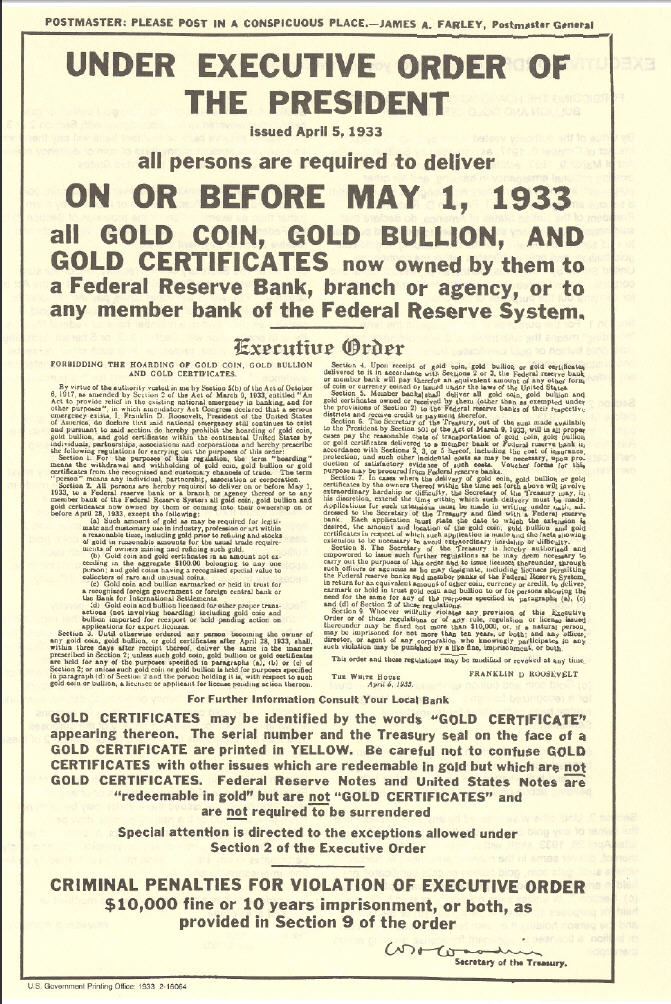
Perhaps the most stunning example of what may be in store for asset managers and pension funds (and possibly retail holders) who dare to challenge central bank monetary authority comes from the Netherlands, where we have just witnessed the 21st century equivalent of Executive Order 6102. The story in a nutshell (and as translated loosely from the primary source presented below): the glassworkers pension fund (SPVG) was ordered by De Nederlandsche Bank (DNB, or the equivalent of the Dutch central bank), that it has to sell the bulk of its gold assets. After the SPVG refused to comply with the order, the DNB went to court and the decision has come out, siding with the central bank, ordering the SPVG to sell the required gold within two months. The pension fund, which invests for 1142 employees, in late 2009 had gold bars worth 34.6 million euros, or about 1400 kilograms. The total fund assets amounted to 288 million euros at that time. The DNB argued gold is a commodity and holding 13 percent was overweight in comparison to the 2.7% average that pension funds are invested in commodities. DNB has found that such a large proportion of gold is inconsistent with the interests of the participants. SPVG sees gold as a medium of exchange, such as euros, but DNB believes that the price of gold fluctuates too much for it to be classified as an investment. Translation of the translation: the central bank has now directly ordered a fund how to allocate its gold assets, because it explicitly disagreed with the fund's statement that gold is money, claiming instead that it is nothing but a very volatile commodity. Very soon no pension funds in the Netherlands will be allowed to hold any amount of gold more than the merely nominal. This latest gold confiscation equivalent event is most certainly coming to a banana republic near you. - ZH
Translated via Google Translation web service:
LJN: BP3625, Rotterdam Court, AWB 11/455 VBC-T2 Print statement
Date of decision: 02.08.2011
Publication date: 09/02/2011
Jurisdiction: Administrative Other
Type of procedure: Provisional
Inhoudsindicatie: DNB pension fund an indication its assets in gold continued to build - depending on the final asset mix to put together - to a rate between 1 and 3%. Although the Fund may be nagegeven that the reasoning of the contested decision brief, is the provisional opinion of the judge in court adequately substantiated why DNB considers that the fund has invested in gold to an extent that an excessive reliance under The fifth paragraph of Article 13 of the Financial Assessment Framework Decision pension yields. In the opinion of DNB provides an investment of 13% of assets in the category of commodities, which that investment is also limited to a commodity, an excessive dependence on the development value of that commodity. DNB notes in this context that pension funds invest on average 2.7% in the category of resources. It also points to the volatility of gold it appears from the plan submitted by the ALM study. The proposition of the Fund rather than gold as a raw material but as a bargaining chip should be seen doing in the opinion of the judge, given the strong volatility of insufficient alter the argument of DNB.
Ruling
LONDON COURT
Administrative Sector
Relief Judge
Reg.nr.: AWB 11/455 VBC-T2
Ruling in response to the request for provisional relief under Article 8:81 of the General Administrative Law
In the case of
Pension Fund United Glassworks, in Gorinchem, the applicant (the Fund)
Agent Prof. E. Lutjens, Amsterdam Bar,
and
De Nederlandsche Bank SA, the defendant (DNB)
Agent Mr. C.M. Bitter, a lawyer in The Hague.
1 Origin and course of the proceedings
By decision of 20 January 2011 DNB indication that the Fund seeks to fund its investment in gold continued phasing out - depending on the final asset mix to put together - to a rate between 1 and 3%. The fund shall submit a plan to draw within two weeks after publication of the designation must be received by DNB. The fund should then plan to be implemented according to the schedule provides a timeline of up to two months after submission to DNB.
Against this decision (hereinafter the contested decision), the fund has any objection.
It has also asked the judge to take a provisional, which includes suspension of the contested decision.
The court hearing took place on February 3, 2011. Parties to be represented by their agent. Furthermore, on behalf of the fund appeared ir D. Ek, who works at Mercer Netherlands BV and adviser to the fund. On behalf of the fund are also some members of the board appeared. DNB on behalf of three employees who appeared under H. Chick.
2 Considerations
2.1 Under Rule 8:81, the first member of the General Administrative Law Act (the AWB) if the court decides against an appeal or, prior to a possible appeal to the court, objection was made or administrative proceedings, the judge of the court having jurisdiction or may be in the main, to request a provisional arrangement where urgency, given the interests involved, is required.
Where the purpose to carry out scrutiny requires that the lawfulness of the contested decision is assessed, has the discretion of the judge is a provisional and not binding on considers that the appeal decision or possibly in the main.
2.2 pursuant to Article 171, first paragraph, of the Pension Act, DNB a pension which does not meet stipulated by or pursuant to that Law, by giving a clue oblige within a supervisory reasonable period with respect to in the designation order points out a certain course of action.
2.3 Article 135 of the Pension Act reads:
"1. A pension fund carries an investment policy consistent with the prudent-person rule and in particular based on the following principles:
a. The values are invested in the interest of entitlement and pension beneficiaries, and
b. (...);
c. The investments are valued based on market valuation.
2. By or pursuant to a Board shall be to ensure the prudent investment policy further rules.
3. The (...) rules under the second paragraph are made regarding the diversification of values do not apply to investment in bonds. "
In the explanatory memorandum of the Pensions Bill includes the following observations (Papers II 2005/06, 30 413, No. 3, p. 258-259):
"The content of this article is based on Article 9BA, as recognized in the Bill to implement Directive 2003/41/EC (II 2004/05, 30 104, No. 2). The investment policy of a pension should be based on the prudent person rule. The prudent person rule is not defined by the Directive. The directive sets out a number of assumptions. The line is best approached on the idea that the values are invested in such a way that the safety, quality, liquidity and profitability of the portfolio as a whole. Also, the values to be invested solely in the interest of the claim and the beneficiaries. (...) "
2.4 Article 13 of the Financial Assessment Framework Decision pension funds (hereinafter: Decision FTK) reads, so far as relevant:
"1. The values are invested in such a way that the safety, quality, liquidity and profitability of the portfolio as a whole are ensured.
2. Values that cover the technical provisions are held to be invested in a manner consistent with the nature and duration of the expected future retirement benefits.
(...)
5. The values are properly diversified so that an excessive reliance on or faith in certain values, or values of a particular issuer or group of undertakings and accumulations of risk in the portfolio as a whole.
(...) "
2.5 On 18 August 2010 at the invitation of DNB a conversation held with a delegation from the board of the fund. During this conversation, DNB has informed the Fund that the fund is too much of the investment portfolio invests in only a "sub-asset class, namely gold, and that therefore there is a concentration risk. In the opinion of DNB, this investment because the risk is not in the interests of participants of the investment fund and should be phased out. The fund has announced the vision of DNB DNB not to endorse. After correspondence back and forth, DNB has the contested decision.
2.6 The fund argues that it is not in violation. It states in this regard that DNB should look at the portfolio as a whole. The fund argues that the goal is to create security for the participants. Because AEX currently very uncertain, it is precisely in favor of gold because it has proved a wise investment. If the fund in 2008 its shares had traded fund for gold would be in a situation of serious underfunding are making conditions, while thanks to the purchase of gold by December 2010 a coverage ratio of 104.7%, higher than the minimum required power. The fund is adequately equipped to monitor the development of the gold price and recently a study done by the ALM policy of the fund supports. The Fund believes that DNB wrongly assumes a concentration risk. Furthermore, argues the fund that there is an unreasonable belangenafweging DNB now fund just very carefully proceeded to the purchase of gold, she has acted in the interest of all participants, in what context they suggesting that the participants' council is behind the management of the fund has ranged, and DNB already using the fund's annual report for 2008 was aware of the investment in gold.
2.7 Although the Fund may be nagegeven that the reasoning of the contested decision brief, is the provisional opinion of the judge in court adequately substantiated why DNB considers that the fund has invested in gold to an extent that an excessive reliance meaning In the fifth paragraph of Article 13 of the Framework Decision yields. From that provision in conjunction with Article 135 of the Pensions follows that - except for investments in government bonds - in the investment portfolio diversification is considered important in the interpretation of the prudent person rule. This diversification is to DNB traced back to the premise that a diversified investment portfolio across different asset classes and different regions, a stabilizing influence on the investment performance, without sacrificing the expected return. In the opinion of DNB provides an investment of 13% of assets in the category of commodities, which that investment is also limited to a commodity, an excessive dependence on the development value of that commodity. DNB notes in this regard datpensioenfondsen average of 2.7% investment in the commodity category. It also points to the volatility of gold it appears from the plan submitted by the ALM study. According to the DNB does not predict when and to what extent a decline will continue. If the gold price implode then the ratio of the fund drop to below 100%. DNB has also stated in court that the fund in which a long-term recovery plan is applicable to this concentration risk acting in breach of Article 16, second paragraph of the Framework Decision. The proposition of the Fund rather than gold as a raw material but as a bargaining chip should be seen doing in the opinion of the judge, given the strong volatility of insufficient alter the argument of DNB.
2.8 DNB's opinion, the judge hearing the criticism of the fund were inadequate eye for the entire assets of the fund invested sufficiently refuted. DNB has argued in this respect that the fact that a large proportion of the fund or in accordance with the Pension invested does not affect the concentration risk that the gold position poses a real risk that the entire capital falls below the required coverage.
2.9 In preliminary opinion of the judge, DNB rightly come to the conclusion that there is a concentration risk under the fifth paragraph of Article 13 of the Framework Decision. The DNB has the financial statements of the fund in 2008 could infer that the fund is too much - then 5% - of the wealth in gold has invested is the opinion of the judge not that DNB is not currently a designation may come. First, the Fund substantially expanded its gold position in 2009, so that more action was pregnant, and secondly, the fund is based on a responsibility to invest within the frameworks of the Pensions Act and the Decree FTK offer. In addition, DNB has not taken immediately to enforcement tools, but it first through consultation sought to move the fund to build its gold position. Finally, the judge found that the fund is not an unreasonable period is needed for its gold position to build.
2.10 The judge will therefore reject the request.
2.11 The judge sees no reason for a court conviction.
3 Decision
The judge,
hereby:
reject the application for a preliminary injunction off.
Thus done by Mr. T. Damsteegt, judge, in the presence of drs R. Stijnen, Registrar.
I don't mean to pick a fight with silver. In fact, I write this post with a heavy heart. But there is so much silver hype right now that I feel I owe it to my readers to at least try to spell out Another perspective. And China is certainly on the minds of the silverbugs these days. How often have we heard about China encouraging its citizens to buy gold and silver lately? (There's that "gold and silver" again.)
...
But did you know that China was practically dumping its silver a decade ago? And to this day it is still a large exporter of silver. Not gold. Just silver. ...
...
Something very interesting happened after Jan. 30, 1934 when Roosevelt devalued the dollar against gold. The price of gold went up 70%. What do you think happened to silver? Did it go up more than gold? Did it shoot the moon? Was it leveraged to gold? No, it dropped like an unwanted rock.
In the latest example that virtually every conspiracy theory is almost always inevitably proven to be fact, the Financial Times reports that JP Morgan, the firm targeted by thousands of "tin foil hat" wearing, conspiratorially-oriented "gold bugs", has cut back on its US silver futures. "JPMorgan has quietly reduced a large position in the US silver futures market which had been at the centre of a controversy about its impact on global prices for the precious metal." And in what can only be considered an unprecedented victory for all those who have over the past year agitated to putting JP Morgan out of business, most recently spearheded by the likes of Mike Krieger and Max Keiser, by forcing a massive short squeeze on its commodities trading desk, we learn that "the decision by JPMorgan was an attempt to deflect public criticism of the bank’s dealings in silver, a person familiar with the matter said. The person added that the bank’s position in silver would from now on be “materially smaller” than in the past." Of course, the latter is pure and total bullshit: as Bart Chilton indicated over the weekend, it is JP Morgan who at one point or another (and possibly very recently) controlled as much as 40% of the silver market, via a massive short. Attempting to make others believe that this short could be covered without pushing the price of the silver metal to over $100/ounce is an indication of either how stupid JPM believes the general population to be, or just how desperate the firm is to end the ongoing short squeeze onslaught. Either way, we are confident that this first unprecedented confirmation that a) JPM is indeed massively short silver and b) that it is hurting bad, will merely redouble efforts to put the world's biggest financial company out of business. Lastly, this means that silver is about to really blast off as the push to really hurt JPM takes off in earnest.
The US regulator, the Commodity Futures Trading Commission, announced in September 2008 that it was investigating complaints of misconduct in the silver market, although it did not name specific entities.
However, JPMorgan said in a statement: “It is absolutely incorrect to say or imply that the Nymex, CFTC or any other exchange or regulator has instructed or asked us to reduce our position.” The bank declined to comment on whether it had reduced its position in the silver market.
The price of silver has risen more than 70 per cent since mid-August to hit a 30-year high of $30.68 a troy ounce last week on the back of a surge in investor buying and a rebound in industrial silver consumption.
In two previous reviews of the silver market, the CFTC has dismissed claims of manipulation. Most analysts say there is little reason to believe the price of silver is being systematically manipulated.
But Bart Chilton, a CFTC commissioner, said in October that he believed there had been “fraudulent efforts” to “deviously control” the silver price. He did not name any party.
Publicly available data on individual traders’ positions are sketchy. In a speech last Wednesday, Mr Chilton said that “earlier this year, one trader held more than 40 per cent of the silver market”. He declined to identify the trader.
The CFTC’s Bank Participation Report shows that one or more US banks held a gross short silver futures position equal to 19.1 per cent of the total number of outstanding contracts in early December. In January the share was 30.2 per cent.
The CFTC only reports data for the US silver futures market, a small corner of the global derivatives market for the precious metal, which is centred in London and largely traded via private over-the-counter deals. The data also do not cover transactions in the physical market.
Analysts and traders said that JPMorgan’s large short positions on New York’s Comex exchange, a division of Nymex, were hedges for the bank’s long positions in physical silver and London’s over-the-counter market.
JPMorgan has invested nearly $3bn over the past two years in its commodities business led by Blythe Masters.
And while we revel in the knowledge that the short squeeze is causing massive pain for JPM, we are far more overjoyed that the days of Blythe Masters as head of JPM's commodities desk is coming to an end: any comparable massive admission of weakness by a trader is always and inevitably followed by some very high profile terminations.
Disclosure: We are long on Sprott Gold Trust, symbol: PHYS. This is NOT our recommendation to buy either Sprott Trust PSLV or PHYS. For the full prospectus and risk factors on the PSLV Trust click HERE.
(As seen on Zero Hedge) Just released from Eric Sprott, Sprott Asset Management:
Regular Markets at a Glance readers may have wondered why we remained so silent on the subject of silver over the last several months. Considering the significant exposure we have to silver as a firm, we can assure you that it wasn’t for lack of desire to share our views, but rather due to strict solicitation restrictions imposed on us by the cross-border listing of Sprott Physical Silver Trust (PSLV) this past October. It therefore gives us great pleasure to finally share our views on silver with you.
We have included two separate articles in this issue of Markets at a Glance: the first was written back in June 2010, and contains the information we used in the prospectus for the PSLV. The second is an update article written this past month that discusses new developments in the silver market and confirms our views on the metal. We urge you to read them both in order to understand our investment thesis for silver, and we hope they compel you to take a much closer look at silver as a long-term investment. Silver’s dramatic rise over the last two months is no fluke - it’s the result of a compelling supply/demand dynamic within a unique market structure. We hope the following articles convey our enthusiasm for "the other shiny metal" as an exceptional investment opportunity.
The Silver Lining, (June 2010)
By: Eric Sprott & David Franklin
No matter how complex our financial system becomes, the economic axiom of supply and demand will still apply. If the demand for an asset outstrips supply, the price of that asset will appreciate. The challenge in finding supply and demand imbalances in today’s market often lies in judging the quality of market data available – it frequently isn’t even close to being accurate. If the numbers don’t show the imbalances, it’s tough for investors to determine if the market price accurately reflects the market dynamics. Nowhere is this more prevalent than in the market for silver.
While gold dominates the headlines, the silver market actually enjoys a superior fundamental supply/demand story than that for gold, although you’d never know it based on the silver demand statistics from the major reporting services. As students of the precious metals markets we monitor the numerous metals reporting services very closely. According to those services, the silver market has enjoyed a stable supply/demand balance for almost ten years now. If that’s the case, why has the price of silver appreciated from $5 to $19/oz over that same time period? Is the reporting services’ data on the silver market truly reflective of silver’s underlying fundamentals?
Although there are several reporting services for silver market information, GFMS Ltd. and The Silver Institute are the most often quoted sources for silver market data. While they provide statistics for both silver supply and demand, it is their neglect of the "investment" demand category that we find problematic. GFMS and The Silver Institute use a category called "implied net investment" to capture the demand for physical silver from institutional and retail investors. The definition for "net investment" as defined by GFMS is "the residual from combining all other GFMS data on silver supply/demand…As such, it captures the net physical impact of all transactions not covered by the other supply/demand variables."1 In other words, it is not an observed figure. GFMS’s "implied net investment" number doesn’t include any observable demand for silver by ETF’s and other reporting entities such as hedge funds - it is merely a plug used to balance the supply data for GFMS’s and the Silver Institute’s reporting purposes.2 As we delved deeper into the silver market, this realization prompted us to calculate our own investment demand statistic.
We present our findings in Table A. While GFMS and The Silver Institute use an implied number, we calculated a real investment demand number using a handful of ETF’s and two other large private investors, one of which is our own firm. Our demand metric is by no means complete or exhaustive - we only used seven sources of reported investment demand, and yet from our informal and incomplete survey we found that GFMS and The Silver Institute had underreported silver investment demand by at least 225 million ounces! This shortfall doesn’t consider any other investors that may have bought silver over the past year, so real demand for silver could be multiple times higher.
Given its seemingly evident market imbalances, you might wonder why silver hasn’t performed better over the last year. The answer, we believe, lies in the way silver is priced. The silver spot price is dictated by paper contracts that trade on the COMEX exchange in New York. Paper contracts can be purchased "long" or sold "short". If more participants sell "short" than purchase "long", the paper market price for silver will decline. Often these contracts have little to no relationship with actual physical silver, and yet they are the most influential contract in determining silver’s physical spot price. Go figure.
In studying the silver market we owe a great debt to the work of silver analyst, Ted Butler. Mr. Butler has been writing about the silver market for fifteen years and has done much to inform investors about the reality of silver’s physical fundamentals. Butler provides some insight into the "short" positions that exist in silver today, highlighting the fact that the eight largest silver traders currently hold a net short position of over 66,000 contracts, representing more than 330 million ounces of silver.11 This means that the eight largest COMEX traders are net short the equivalent of 48.5% of the world’s total annual silver mine production of 680.9 million ounces. None of these traders are in the silver business by the way – they’re all financial institutions. In addition, the COMEX silver short position held by the eight largest traders on May 3, 2010, represented 33% of total world silver bullion inventory, estimated by Butler to be approximately one billion ounces. There is no real comparison with gold, as the 24.5 million ounce concentrated net short position held by the eight largest traders represents a mere 1.2% of the 2 billion+ ounces of world gold bullion inventory as reported by the World Gold Council.12 So in comparison to total world bullion inventories, the concentrated short position in silver is 27 times larger than that for gold. In every comparison possible, the short position in COMEX silver contracts is off the charts, and if you think the short positions sound potentially disruptive, you’re not alone. In September 2008 the CFTC confirmed that its Division of Enforcement has been investigating complaints of misconduct in the silver market. This investigation is ongoing and we look forward to its resolution.13
Because we believe the demand for precious metals will continue to increase in this environment, we’re always interested to know the total supply available in today’s physical bullion market. According to the best estimates from the USGS and current mining statistics, approximately 46 billion ounces of silver have been mined since the dawn of civilization.14 In comparison, approximately 5 billion ounces of gold have been mined throughout history.15 Reading this, a casual observer might conclude that gold is currently justified in being worth more than silver based on its relative scarcity. But the current price discrepancy ($1,250/oz gold vs $19/oz silver) is misleading.
As mentioned above, there are only 1 billion ounces of silver left above ground in bullion form today. That is a surprisingly small number in relation to the 46 billion ounces mined throughout history. The reason is due to silver’s consumption in manufacturing. Just like other industrial minerals, silver has been consumed in various processes over the course of history. Silver’s superiority in heat transfer, conductivity and light reflectivity make it unique, and it boasts anti-microbial properties that make it ideal for surgical instruments, clothing materials and certain medical applications. The key point to remember with all these applications is that once the silver is consumed it is typically never recycled. Many of its industrial applications require such small amounts in each surgical tool, electronic device or clothing item that it isn’t economic to recover from garbage dumps. For comparison, there are currently approximately two billion ounces of gold above ground in bullion form compared with the 5 billion ounces of gold mined throughout history.16So despite being more heavily mined over time, silver bullion is now the more scarce "precious" metal than gold bullion is from an investment supply perspective.
This is where the silver story gets interesting for us. At today’s prices you have $19 billion dollars of silver ($19 x 1 billion ounces) and $2.5 trillion dollars of gold ($1250 x 2 billion ounces) above ground in bullion form. The size of the investment market for gold is therefore 131 times larger than that for silver. And yet, on a market relative dollar basis, investors are actually buying more silver than they are gold today. At today’s metals prices, in dollar terms, the US mint has sold approximately three times more value in gold than in silver thus far in 2010 coin sales. But there should be 131 times more gold sold than silver for the market to stay in balance. None of the largest gold and silver investment vehicles reflect the 131:1 ratio, suggesting that investors have a disproportionately large interest in owning physical silver.
For example, the largest gold ETF today, the SPDR Gold Trust ("GLD"), is currently ten times the dollar value of the largest silver ETF, the iShares Silver Trust (SLV). Since the SLV began trading in April 2006, the GLD has increased by $8 for every $1 increase in SLV’s NAV. Again, given the choice, investors are voting with their dollars and putting disproportionately more dollars into silver than gold from a relative market size perspective. It appears that no investors are anywhere close to buying 131 times more gold than silver, which market metrics would suggest if the demand for gold and silver were relatively equal – all of which brings us to silver’s ‘supply conundrum’: If on the supply side, as Ted Butler calculates, there are only one billion ounces of silver left in bullion form available for investment; and if, on the demand side, we were able to identify the holders of 500 million ounces spread across a mere seven investors - it implies that there is only 500 million ounces of silver left for everyone else to invest in! As large holders of silver bullion ourselves, we can tell you that 500 million ounces is not that much from a global perspective, and certainly won’t be enough to satiate the world’s investment demand for silver going forward. Also let us not forget the large silver short position on the COMEX that will almost undoubtedly require the purchase of 330 million ounces of silver to eventually cover. Assuming that happens, most of the silver available for investment will essentially already have been spoken for.
It also serves to mention that there will be no government silver stocks capable of covering this impending supply shortfall. According to the latest audit, the US treasury currently has 7,075,171 oz of silver in storage, which is about enough to handle two months of silver eagle coin production. If the COMEX silver short sellers are ever forced to cover, they won’t be able to lean on the government for a physical bailout.17
Judging by the numbers above, if hedge funds or any other large investor ever decided to invest in the physical silver market with the same voracity as they did with gold, the silver price could potentially explode. The existing silver inventory at COMEX is currently worth a little more than $2 billion at today’s silver price. We already know that high-profile hedge fund managers like Soros, Paulson and Einhorn have gold holdings with a total value of over $5 billion.18 If that same purchasing power was ever applied to the silver market, we could potentially witness a dramatic rise in the silver price and an effective clearing of all the physical silver in the COMEX inventory. It deserves mention that the SPDR Gold Trust ("GLD") added almost $5 billion dollars worth of gold in the last month alone, and it would take less than half of that GLD gold investment to wipe out the entire silver COMEX inventory.
The bottom line for us is that silver appears to be a fantastic investment today. Limited supply, strong demand and a potential buyer of almost half of one year’s global mining silver output make a great case for owning silver in physical form. Based on our calculations, it appears that the silver investment demand statistics published by GFMS and The Silver Institute are highly misleading at best. We believe the investment demand for silver is multiple times higher than that published, and given the outrageous short position in silver on the COMEX, coupled with the unsustainable buying ratios relative to gold, the case for physical silver is simply outstanding. As the expression goes, "every cloud has a silver lining". Notice it isn’t a gold lining or a platinum lining. In the silver market, the cloud has been duly represented by poor estimations of investment demand coupled with large outstanding short positions. That cloud will soon lift, revealing a "silver lining" that is far more valuable than it is today.
All that Glitters is Silver (November 2010)
By Eric Sprott & David Franklin:
In the four months since we filed the prospectus for the Sprott Physical Silver Trust on July 9, 2010, the silver price has rocketed up 54%, bringing its year-to-date return up to a stunning 68% (!!). Silver has now outperformed all of the other eighteen commodity components that comprise the CRB Commodity Price Index on a year-to-date basis. Silver has been the indisputable star of 2010, and we have been very long the physical metal in many of our mutual funds and hedge funds.
Silver’s performance since June has been influenced by a number of factors. The first and arguably most significant development took place on October 26, 2010 when comments were released by Bart Chilton of the Commodity Futures and Trading Commission (CFTC). The CFTC is the US government agency that supposedly regulates the US futures and options markets. While the CFTC has technically been "investigating" the silver market since 2008, it had revealed nothing about its findings for over two years. Everything suddenly changed when Mr. Chilton, a CFTC Commissioner no less, publicly stated that, "I believe that there have been repeated attempts to influence prices in the silver markets. There have been fraudulent efforts to persuade and deviously control that price. Based on what I have been told by members of the public, and reviewed in publicly available documents, I believe violations to the Commodity Exchange Act (CEA) have taken place in silver markets and that any such violation of the law in this regard should be prosecuted (emphasis ours)."1 These comments quickly triggered a flurry of lawsuits against the purported manipulators and set the silver market on fire. There are now no less than four lawsuits seeking class action status. They all allege that JP Morgan Chase & Co. and HSBC Securities Inc. colluded to manipulate the silver futures market beginning in the first half of 2008. The suits claim that the two banks amassed massive short positions in silver futures contracts that they had no intent to fill in order to force silver prices down for their furtive benefit.
The suits also describe two ‘crash’ events that were set in motion by JP Morgan and HSBC, one in March 2008, and the other in February 2010, after the defendants had amassed large short positions. The suits allege that COMEX silver futures prices subsequently collapsed to the benefit of both banks in the wake of these events.2 The fallout from these accusations has undoubtedly increased the investment demand for silver, and it serves to remember, as we highlighted in the previous article, that investment demand was already understated by at least half by the major silver reporting agencies. It will be hard for them to downplay the recent demand increase, as the volume of silver contracts traded on the COMEX market on November 10th set a new record, surpassing the previous record set in December 1976 by 57%!3 This increase actually forced the CME Group to increase the margin requirements for COMEX silver futures twice in one week in order to maintain some semblance of market order.4
Silver coin sales as reported by the world’s major mints have also been exploding since Chilton’s comments were made. The US Mint, The Royal Canadian Mint, The Austrian Mint and The Perth Mint are all reporting record or near record sales of silver coins.5 The silver Eagle produced by the US Mint set three new records at various points in November: best annual sales, best silver Eagle mintage, and best ever month.6 Money is pouring into silver in all forms, and due to silver’s relatively small market size, this capital inflow is having a huge impact on the silver spot price.
As we outlined in our Sprott Physical Silver Trust prospectus and our June MAAG article, the physical silver market is surprisingly small in US dollar terms. The CPM Group estimates that above ground stocks of physical silver total 1.184 billion ounces in bar and coin form, implying a total silver market size of a mere US$33.15 billion dollars.7 At the end of 2009, approximately 500 million ounces of that 1.184 billion were already accounted for by the silver ETF’s and other large holders. This left approximately 684 million ounces of silver available for sale in 2010. That is hardly enough, in our opinion, to satiate demand.
The money flows into silver in November 2010 have been staggering. Consider the investment demand generated from only two sources: the iShares Silver Trust ETF (SLV) and US Mint coin sales. The SLV added approximately 18 million ounces of silver in November alone; the US Mint sold 4.2 million ounces of silver coins. If you multiply these amounts against today’s silver price of $28, money is flowing into the silver market at an annualized rate of $7.5 billion dollars! At that rate of demand, it won’t take long before all the remaining above ground silver is spoken for.
Silver’s demand profile may also benefit from the outrageous short position that exists in the silver COMEX market. The current ‘open interest’ in silver COMEX contracts totals an approximate 871 million ounces (!!!).8 This means there are paper contracts for over 871 million ounces of silver that have someone betting ‘long’ and someone else betting ‘short’. In the event that the ‘longs’ choose to take physical delivery, there will not be enough silver to supply each buyer. It’s simple math - with only 684 million ounces of silver available above ground, there won’t be enough silver to go around. And considering the rate with which people have been purchasing coins and silver bars this past month, there may not even be enough physical to satiate regular spot buyers, let alone futures market participants.
Considering all the recent developments in the silver market, it seems unlikely that the silver price will stay under $30/oz for long. The large quantity of money flowing into silver from investors, combined with the potential demand from those who are ‘short’ silver that they do not own, will likely end up swamping the physical silver market entirely.
As our dear friend, Marc Faber, espouses in his book "Tomorrow’s Gold", an investor can do very well by only making a few good investment decisions over his or her career. The trick is to make one good investment decision every decade or so, based on trends that will last a number of years.9 In our view, owning physical silver and the associated stocks represents that type of investment opportunity today. If that seems too simplistic, consider that in October 2001 we wrote an article that identified the investment of the last decade. It too was just a simple metal. The article was entitled "All that Glitters is Gold", and it was written when gold was still considered a relic in financial circles. We believe silver will be this decade’s gold, and judging by the recent price action, it’s already off to a great start.